Available courses

This course examines post harvest handling, packinghouse operations, and packaging technology for fresh and durable crops. Students will critically evaluate materials, systems, and practices used to sort, handle, and protect produce quality and food safety from harvest through market preparation, with emphasis on the Nigerian post harvest loss context.


Course banner image for MTE 811 Agricultural Produce Packaging Systems.

This course module aims to provide students with a comprehensive understanding of produce packaging techniques for effective postharvest management of agricultural crops. The course will cover topics such as packaging materials, design considerations, storage conditions, transportation, and quality control. Students will learn about the role of packaging in minimizing postharvest losses, maintaining product quality, and extending shelf life. Practical case studies and hands-on activities will be included to enhance students' problem-solving skills and critical thinking in the field of produce packaging.

International Comparative Research on Vocational Education and Training –  Research – Department of Teacher Education - NTNU

This course covers issues and methods of reseach in vocational and technical education.


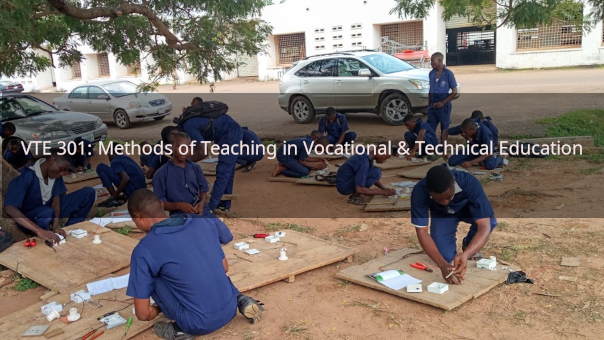
This course is designed to equip students with the essential teaching methods and strategies used invocational and technical education. The course emphasizes the development of practical skills and the effective integration of theoretical concepts in delivering quality vocational and technical education. Students will learn various instructional methods and techniques, assessment and evaluation strategies, curriculum development, and classroom management.

ITE 311 introduces third-year Technology Education students to the theory and practice of teaching technical subjects at the secondary and vocational levels. As students who are themselves trained in a technical discipline, this course develops the pedagogical competencies needed to effectively communicate complex technical and psychomotor knowledge to learners. Topics include learning theories applicable to technical education, the major instructional methods used in workshop and laboratory settings, lesson planning, development of instructional materials, classroom and workshop management, and the use of ICT in blended technical instruction. The course culminates in a supervised micro-teaching exercise — one of the CCMAS-prescribed learning modes for Education graduates — providing students with their first formal teaching experience.


This hybrid, practice-oriented course equips postgraduate teacher-trainees in Industrial Technology with the skills to design, conduct, and report rigorous educational research grounded in workshop and laboratory settings. At the end of the course, you will be prepared to:

  • formulate researchable problems and align them with appropriate quantitative, qualitative, or mixed-methods designs;

  • develop and pilot robust data-collection instruments (surveys, observation checklists, interview guides) and establish their validity and reliability;

  • perform descriptive and inferential statistics in SPSS and thematic coding with CAQDAS tools, interpreting outputs accurately; and

  • craft an APA-compliant mini-research report suitable for journal submission or TETFUND proposals.

Learning activities blend mini-lectures, hands-on analytics labs, peer critique workshops, and self-paced quizzes, with completion badges marking your progress. Assessments include an instrument validation portfolio, data-analysis tasks, and a capstone research report. Successful participants will leave with a ready-to-implement study and the confidence to mentor others in evidence-based practice within industrial-technology education.

This course empowers PhD students in Industrial Technology Education to leverage information and communication technologies (ICT) for cutting-edge research, data-driven decision-making, and innovative pedagogical practices. Participants will gain expertise in computational data processing, data management, and software applications relevant to their field. Hands-on experience and practical projects will be emphasized throughout the course.

Introduction and orientation to the field of metal. Basic technical information and laboratory work in metal processes and fabrication. This includes work in the areas of welding, forging, foundry, sheetmetal, and metal machining. A variety of projects will be made to demonstrate the different processes.

ENT 312 Venture Creation is a 2-unit, 15-week course for 300-level students at MOAU CEID. Every student team registers a CAC-registered startup and presents it for incubation at the MOAU UniPod Innovation Hub on Demo Day (Week 15). The course runs across four phases: Discovery (Weeks 1-4), Formation (Weeks 5-8), Development (Weeks 9-12) and Launch (Weeks 13-15).